Ireland, Jazz, Dublin Zoo, Bloody Sunday and the Athlone Musical Society
Written March 2017
Last year marked the hundredth anniversary of the 1916 Rising and, if you’re a jazz fan, you may be aware that this year (2017) sees the hundredth anniversary of the first jazz recording, by the Original Dixieland Jass Band (or Original Dixieland Jazz Band as they came to be known), in 1917.
Jazz didn’t start in 1917, of course. It’s hard to say it started at any particular time. Instead, the music changed over time and at some point the name jazz stuck. It’s messy. Jazz meant different things to different people as much in 1917 as it does now. The all-white ODJB weren’t the first jazz band, just the first to record and claim ownership of the name. Critic Kevin Whitehead makes the good point that genre was as intangible then as it is today, and that the journey to the first jazz recording was a gradual one. You can listen to an NPR programme that discusses some of his ideas.
So what does any of this have to do with Ireland? Early jazz in Ireland has been largely ignored by just about everyone, often, I think, because what it seemed to represent then is difficult to reconcile with how we understand jazz performance today. As part of my PhD research I looked into early jazz performance in Ireland, and in particular Dublin, and was surprised by what I found. Here I want to focus on what my research indicates was the very first jazz performance in Ireland.
The Zoo Ball
For non-Irish readers, a little background in one sentence. Following the Easter Rising of 1916, the Irish War of Independence was fought between 21 January 1919 and 11 July 1921, closely followed by the eleven-month Civil War from 1922 to 1923 and the establishment of the Irish Free State on 6 December 1922.
In this turmoil, jazz was not a priority for even the most cosmopolitan Dubliner. Jazz was very much a dance music, and who had time for that in 1919? Well, to be a little facetious, the British armed services and their visiting friends from the US armed services may have had time (in fairness, everyone dances in times of strife).
The Irish Independent of 15 February 1919 reports that “Mr Gordon’s ‘Jazz Band’ of 5 U.S.A. Naval men in uniform” were the “principle attraction” at the Zoo Ball held the previous night in the Royal College of Surgeons. Three hundred attended (supper was served at midnight), including “many officers of the Army, Navy and Air Force”. Most of the column lists the dignitaries present.1
The December 1918 election had resulted in a landslide for Sinn Féin, whose MPs abstained from taking their seats at Westminster. They formed the first Dáil instead and declared independence on 21 January 1919. The War of Independence would not escalate until later that year. Twenty-four days later, British forces were dancing to jazz in the Royal College of Surgeons on St Stephen’s Green, a stone’s throw from the Mansion House on Dawson Street, where the first Dáil had declared independence.
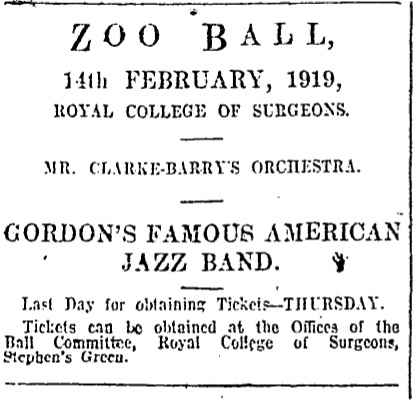
Of further interest to Dublin musical history is that “every alternate dance” was played by Mr John Clarke-Barry’s band. John Clarke-Barry was the father of Billie Barry, who went on to found the Billie Barry Stage School, which is still going. Clarke-Barry’s band often played in Anglo-Irish circles (a term for a privileged, mostly Protestant social class in Ireland). The Billie Barry Stage School, of course, has no political leanings. In fact I played at the school’s 50th anniversary event in the Mansion House in 2014, becoming a very small part of the story I was researching at the time.
Is the jazz immoral?
Mr Clarke-Barry had one of the most successful Irish dance bands of the time, but didn’t seem to embrace the changes jazz was bringing. In November 1919 there was a court case when a retired cadet and a captain from the British army applied for a music and dancing licence for 35 Dawson Street. Two ratepayers and the Vigilance Association (a Catholic organisation mainly concerned with censoring “immoral” films and literature) opposed it. Counsel for the applicants said that two members of the band had also served in the war, “and the fact that these people fought in the war might account for the bitter opposition to the application”.2
The war here is the one that became known as World War I. Again for non-Irish readers: although Ireland was part of the United Kingdom during the war, many in Ireland had long been fighting for independence, and the movement was coming to a head. For many Irish people, fighting on the British side was seen as a betrayal, and the treatment of Irish people who served in the British army in both world wars is still debated today. The article doesn’t say whether these band members were Irish or British, and it wouldn’t settle much either way. Identities were complicated then, as now.
The article also says the band “had two coloured men brought from London” and was already playing in the Café Cairo.3 The Café Cairo was at 59 Grafton Street. The name “Cairo Gang” was later given to a group of British intelligence officers believed to have met there, who were killed by the IRA on the morning of 21 November 1920 as part of the events of Bloody Sunday.4
To return to Mr Clarke-Barry: he was called in, presumably as an expert witness, and declared that he “did not provide jazz in the vulgar sense”, and later in the article, “The distortions introduced by the coloured members make the music vulgar. Exaggerated jazz music by nigger musicians is most decidedly suggestive and indecent.”5 This was not the first time jazz had been cast as both racialised and sexualised. That had been going on since it first appeared, and the same charge had been made against ragtime before it.
The following day, though, a writer signing as “J.H.C.” declared that “the dreaded jazz” was really “[j]ust the one-step, danced double-quick to the same old music with the simple addition of pandemonium effects”.6 The hysterics were dropped for at least a day.
Mr Harry Foy’s Jazz Quartette Band
It was either good timing or opportunism that only four days after the “immoral jazz” controversy in the Irish Independent, Mr Harry Foy of Church Street, Athlone, was advertising “Mr. Harry Foy’s Jazz Quartette Band” in the Connacht Tribune.7
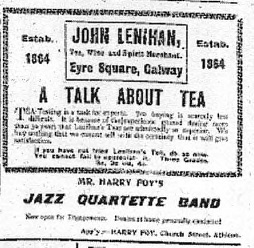
The 1911 census shows that Henry Foy lived on Church Street, Athlone, was a professor of music and was born in Westmeath. He was 30 at the time of the census, so about 38 in 1919. His musical enterprise started well before this: he co-founded the Athlone Musical Society, Ireland’s oldest musical society, in 1902, at around the age of 21.8
I find it fascinating how quickly the idea of jazz was taken up, not just by dancers but by musicians. We’ll probably never know what sort of music Harry Foy was making, or why he started what was very probably Ireland’s first jazz band, but it was the beginning of a practice of music-making that continues today. That he was advertising his services points to the economics. We like to think of jazz as an art music today, and it is, but it has never been disconnected from economics. Harry Foy’s case also shows the ease and speed with which a Black music could be taken up by a completely different culture: the beginning of a relationship between Europeans and Black music that has produced both pleasure and pain ever since.
Further early jazz performances in Dublin show up in the press: the Cocktail Syncopators at the Theatre Royal, “introducing Singing and Dancing, and their Famous Jazz Band”, on 1 May 1923; the “Famous Dixie Minstrels (Come and hear their Jazbos Band)” at the Tivoli Theatre in 1925; and “Noni and his famous jazz band, the Golden Serenaders” at the Theatre Royal in 1927.9
Most of this comes from my PhD thesis, which is free to download. I’d love to hear your thoughts: damian@damianevans.net.
Footnotes
-
“The ‘Jazz Band’ at the Zoo Ball”, Irish Independent, 15 February 1919, 6. ↩
-
“Is the Jazz Immoral?”, Irish Independent, 25 November 1919, 5. ↩
-
Ibid. ↩
-
Peter Cottrell, The Anglo-Irish War: The Troubles of 1913–1922 (Osprey Publishing, 2006), 53. ↩
-
“Is the Jazz Immoral?”, Irish Independent, 25 November 1919, 5. ↩
-
J.H.C., “To-day & Yesterday”, Irish Independent, 26 November 1919, 4. ↩
-
“Mr Harry Foy’s Jazz Quartette Band”, Connacht Tribune, 29 November 1919, 8. ↩
-
“Pages from the Past”, Westmeath Independent, 29 February 2012. ↩
-
“Theatre Royal Advertisement: Cocktail Syncopators”, Irish Times, 1 May 1923, 4; “Dixie Minstrels”, Irish Independent, 4 March 1925, 10; “Public Amusements”, Irish Times, 11 March 1927, 6. ↩